
Dental Implant Procedure Explained 2026: What to Expect
Table of Contents
What Are Dental Implants and How Do They Work?The Parts of a Dental Implant
The Parts of a Dental Implant
The Dental Implant Procedure: Step-by-Step in 2026Stage 1: Consultation, CBCT Imaging, and Candidacy ScreeningStage 2: Digital Treatment Planning and Surgical Guide FabricationStage 3: Implant Body PlacementStage 4: Osseointegration, The Quiet MonthsStage 5: Abutment PlacementStage 6: Final Restoration FittingDigital Planning with 3D Cone Beam CT and Surgical GuidesPlacing the Implant Body and Abutment
Stage 1: Consultation, CBCT Imaging, and Candidacy Screening
Stage 2: Digital Treatment Planning and Surgical Guide Fabrication
Stage 3: Implant Body Placement
Stage 4: Osseointegration, The Quiet Months
Stage 5: Abutment Placement
Stage 6: Final Restoration Fitting
Digital Planning with 3D Cone Beam CT and Surgical Guides
Placing the Implant Body and Abutment
Same-Day Dental Implants: Who Qualifies and What to Expect
Your Dental Implant Recovery Timeline: Week by Week
Choosing Dental Implant Specialists: What to Look For
Risks, Costs, and Long-Term MaintenanceRisks and Complications: What Actually Goes WrongHow Implant Costs Are StructuredA Lifetime Maintenance Protocol for 2026
Risks and Complications: What Actually Goes Wrong
How Implant Costs Are Structured
A Lifetime Maintenance Protocol for 2026
Frequently Asked Questions
Last Updated: September 12, 2026
What Are Dental Implants and How Do They Work?
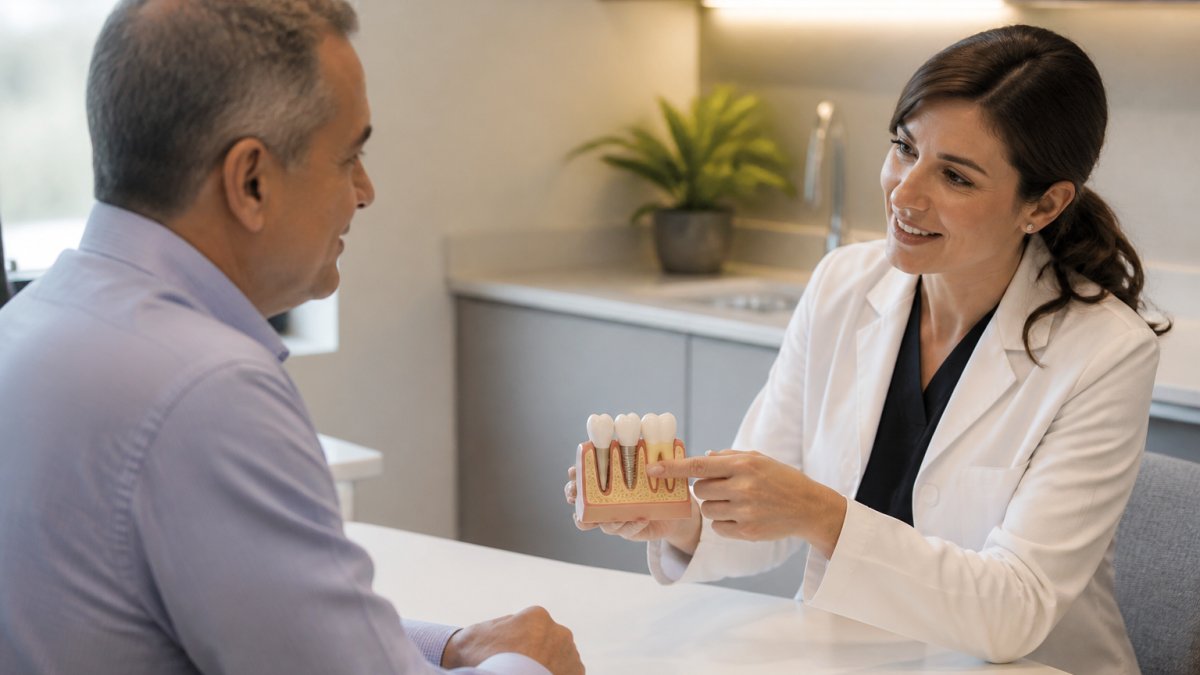
A dental implant is a titanium post surgically placed into the jawbone to serve as an artificial tooth root, supporting a crown, bridge, or denture. Understanding the dental implant procedure starts with knowing what each component does and why the body accepts it.
The process relies on osseointegration, where the jawbone fuses with the titanium surface over several months. This biocompatibility is what separates implants from every other tooth-replacement option: they don't just sit in your mouth, they become part of it.
Most patients considering this treatment are dealing with edentulism or failing teeth and want a permanent answer, not another temporary fix.
The Parts of a Dental Implant
Three components make up every implant:
Implant body: the titanium post embedded in the jawbone
Abutment: the connector that sits above the gum line
Crown: the visible artificial tooth attached to the abutment
Some modern systems use zirconia instead of titanium for the implant body. Both materials work, but they behave differently in the mouth, and that difference matters for the long-term maintenance section below.
The Dental Implant Procedure: Step-by-Step in 2026
The dental implant procedure in 2026 is less a single event than a staged treatment sequence spread across several months. Digital treatment planning has removed much of the guesswork that used to define implant dentistry, but the underlying biology, bone fusing to metal, still sets the pace. Here is what each stage actually involves.
Consultation, imaging, and 3D cone beam computed tomography (CBCT) scan
Digital treatment planning and surgical guide fabrication
Implant body placement under local anesthesia
Healing period (osseointegration)
Abutment placement
Final crown or restoration fitting
Each step builds on the last. Skip the planning, and you're gambling with the outcome.

Stage 1: Consultation, CBCT Imaging, and Candidacy Screening
The first visit is diagnostic, not surgical. Your clinician reviews your medical history, takes periapical and panoramic radiographs, and, critically, orders a 3D cone beam computed tomography scan. CBCT produces a volumetric model of the jaw that shows bone height, bone width, density in Hounsfield units, the inferior alveolar nerve canal, the maxillary sinus floor, and the position of adjacent roots.
That scan is also where candidacy gets settled. Adequate bone volume, healthy gum tissue, controlled systemic conditions (well-managed diabetes, for example), and no active periodontal disease are the usual green lights. Smoking, uncontrolled bruxism, and certain medications that affect bone metabolism are the common yellow and red flags. If bone is insufficient, a graft or sinus lift is planned here, not discovered mid-surgery.
Stage 2: Digital Treatment Planning and Surgical Guide Fabrication
Planning software imports the CBCT data and lets the clinician position a virtual implant in three dimensions: mesiodistal spacing, buccolingual angle, and apicocoronal depth. The restorative outcome is designed first, where the final crown needs to sit, and the implant is then placed to support it. This is called prosthetically driven or backward planning, and it is the standard of care in 2026.
From that plan, a surgical guide is fabricated (often 3D-printed) that seats over the teeth or gums and directs the drill to the pre-planned trajectory. The practical effect is sub-millimeter positional accuracy, shorter chair time, less flap reflection, and fewer surprises near nerves or sinuses. A surgeon who skips CBCT imaging and freehands placement is working blind.
Stage 3: Implant Body Placement
On surgery day, the site is anesthetized with local anesthetic; IV sedation is an option for anxious patients or longer cases. The surgeon makes a small incision (or, in flapless guided cases, a tissue punch), prepares the osteotomy with a graduated series of drills, and threads the implant body into place. Torque at insertion is measured, typically a reading of roughly 30-35 Ncm or higher is considered good primary stability, though the exact threshold varies by system and bone quality.
A cover screw or a healing abutment is then placed, and the site is closed. Single-implant placement usually runs one to two hours; multiple implants or grafting extend that. Most patients leave with a soft-food diet, a cold compress schedule, and a prescription or over-the-counter pain plan.
Stage 4: Osseointegration, The Quiet Months
This is the part patients underestimate. Osseointegration is the biological process in which bone cells grow directly against the implant surface, with no soft tissue layer in between. It is not something you can see or feel happening. The typical healing window is three to six months in the mandible and somewhat longer in the maxilla, where bone is less dense (PubMed). Loading the implant too early, or ignoring post-op restrictions, can compromise the interface.
Stage 5: Abutment Placement
Once integration is confirmed, usually by a combination of clinical stability testing and follow-up imaging, a small second-stage procedure exposes the implant and attaches the abutment, the connector that transitions the implant through the gum line. In single-stage and same-day protocols, the healing abutment or a provisional crown may already be in place, so this step is folded into the earlier surgery.
Stage 6: Final Restoration Fitting
Impressions (digital intraoral scans in most modern practices) are taken of the abutment and surrounding teeth, and the final crown, bridge, or denture is fabricated and seated. Bite, contacts, and margins are checked and adjusted. From this point, the implant is functionally complete, but the maintenance phase, covered later in this article, is what determines how long it lasts.
Key Takeaway Every stage has a decision point that affects the next one. The two that most influence long-term success are the CBCT-based plan (Stage 2) and how strictly you protect the site during osseointegration (Stage 4).
Digital Planning with 3D Cone Beam CT and Surgical Guides
Digital treatment planning uses 3D cone beam computed tomography to map jawbone density, nerve locations, and sinus cavities before any incision is made. A surgical guide is then fabricated from that scan, directing the implant to a pre-planned position with sub-millimeter accuracy.
What most guides miss is that this planning step is where complications get prevented. A surgeon who skips CBCT imaging is working blind.
Placing the Implant Body and Abutment
The implant body is placed through a small surgical incision in the gum, then secured into the jawbone. Local anesthesia keeps the patient comfortable, and the procedure typically takes one to two hours per implant.
The abutment is usually attached after osseointegration completes, though same-day protocols change that timeline. Your surgeon decides based on jawbone density and initial stability.
Same-Day Dental Implants: Who Qualifies and What to Expect
Same-day dental implants are possible when the implant achieves sufficient initial stability in healthy bone. Not every patient qualifies, and any provider who promises same-day results without a CBCT scan first is skipping a critical step.
Candidates generally need adequate jawbone density, no active gum disease, and good overall health. Patients who've worn dentures for years often need bone grafting first, which extends the timeline.
At Royal Dental at The Villages, our team has over 30 years of experience, and IV sedation is available for patients experiencing dental anxiety.
Pro Tip Ask your provider to show you the CBCT scan and explain your bone density numbers before committing to same-day treatment. If they can't walk you through the imaging, that's a red flag.
Your Dental Implant Recovery Timeline: Week by Week
The dental implant recovery timeline varies by patient, but most follow a similar arc. Knowing what's normal at each stage prevents unnecessary worry.
Phase | Timeline | What to Expect |
Immediate post-op | Days 1-3 | Swelling, mild discomfort, soft-food diet |
Early healing | Weeks 1-2 | Sutures dissolve or removed, swelling subsides |
Osseointegration | Months 2-4 | Implant fuses with bone, no visible change |
Abutment and crown | Month 4-6 | Final restoration fitted, full function restored |
Most patients return to normal activities within a few days. The healing period for osseointegration happens quietly underneath, which is why the "out of commission" fear is usually overstated.
Choosing Dental Implant Specialists: What to Look For
Dental implant specialists should have verifiable training in implant dentistry, access to 3D imaging, and a track record with cases like yours. A periodontist or prosthodontist brings different strengths, so match the specialist to your needs.
Questions worth asking:
Do you use computer-guided surgery or freehand placement?
How many full-mouth restorations have you completed?
What's your protocol if an implant fails to integrate?
Do you handle both the surgical and restorative phases in-house?
That last question matters more than most patients realize. Bouncing between a surgeon and a separate restorative dentist creates communication gaps that affect fit and aesthetics.
Risks, Costs, and Long-Term Maintenance
Most implant guides stop at the final crown. That is a mistake, because the decisions made after restoration, and the risks that surface years later, are what determine whether an implant lasts five years or thirty. This section covers complications, how pricing actually breaks down, and a lifetime maintenance protocol that goes beyond "brush and floss."
Risks and Complications: What Actually Goes Wrong
Implant failure is uncommon but not rare enough to ignore. The complications clinicians see most often fall into three buckets:
Early failure (before osseointegration completes): usually traced to infection at the surgical site, poor bone quality or quantity, smoking, uncontrolled diabetes, or premature loading. This is why the healing window matters.
Peri-implant mucositis: reversible inflammation of the soft tissue around the implant, analogous to gingivitis. Bleeding on probing and redness are the signs. Treated early, it resolves.
Peri-implantitis: the more serious cousin, inflammation plus progressive bone loss around the implant. Left unchecked, it can lead to implant loss. It is largely preventable with hygiene, but it is also the reason long-term maintenance is not optional.
Less common risks include nerve injury (numbness or tingling in the lip, chin, or tongue), sinus complications with upper implants, and mechanical failures such as screw loosening or crown fracture. A well-planned case using CBCT and a surgical guide reduces, but does not eliminate, the anatomical risks.
Watch Out Any implant that is mobile, painful, or bleeding persistently should be evaluated promptly. Early intervention is the difference between saving an implant and replacing it.
How Implant Costs Are Structured
Implant pricing is not a single number. It is a stack of components, and understanding the stack is how you compare quotes honestly:
Imaging and planning: CBCT scan, treatment planning software, and surgical guide fabrication
Surgical phase: implant body, bone graft or sinus lift if needed, anesthesia or sedation
Restorative phase: abutment, impression or digital scan, and the final crown, bridge, or denture
Maintenance: exams, radiographs, and professional cleanings over the life of the implant
A quote that lists only "implant + crown" is almost certainly leaving out grafting, imaging, or the abutment. Ask for an itemized breakdown before you commit. Insurance coverage varies widely, some plans cover the restorative portion but not the surgical, and many cover neither. Financing and in-house membership plans are common ways patients spread the cost.
A Lifetime Maintenance Protocol for 2026
This is the part most guides skip. An implant has no periodontal ligament and no nerve supply, which means it cannot feel pain and cannot signal early trouble the way a natural tooth can. You have to inspect it deliberately.
Daily:
Brush twice with a soft-bristled or electric toothbrush; angle the bristles toward the gum line around the implant.
Clean between the implant and adjacent teeth with interdental brushes, floss threaders, or a water flosser. Standard floss alone often misses the implant-abutment junction.
Use a low-abrasive toothpaste; abrasive pastes can scratch the abutment and crown over time.
Professional:
Exams and radiographs at least annually to monitor bone levels around the implant.
Professional cleanings twice yearly, and specifically, cleanings performed with implant-safe instruments. Standard metal scalers can scratch titanium and create a surface that harbors bacteria (PubMed). Ask whether your hygienist uses titanium, plastic, or carbon-fiber instruments and a non-abrasive polish.
Lifestyle:
If you grind or clench, wear a night guard. Implants do not have the shock-absorbing ligament that natural teeth do, so occlusal forces transfer directly to bone.
Keep blood sugar controlled if you have diabetes; glycemic control is one of the strongest predictors of long-term implant survival (PubMed).
Stop smoking. It is the single most modifiable risk factor for both early failure and peri-implantitis.
What to watch for:
Bleeding when you brush around the implant
Redness, swelling, or a bad taste near the site
A crown that feels loose or a bite that feels different
Any mobility of the implant itself, this is an emergency, not a wait-and-see
Patients who treat implants like natural teeth, and who keep their maintenance appointments, routinely keep them for decades. Patients who treat the final crown as the finish line are the ones who end up back in the chair.
The psychological side deserves mention too. Many patients who've hidden their smile for years describe the shift after restoration as transformative, not just cosmetically but socially.
Frequently Asked Questions
What I wish I knew before dental implants?
Most patients wish they had known that the dental implant procedure is usually less painful than expected. Local anesthesia keeps you comfortable during surgery, and most discomfort afterward is managed with over-the-counter pain relievers. The bigger surprise is the timeline: while same-day dental implants can give you teeth in 24 hours, full osseointegration (where the titanium post fuses with your jawbone) takes several months. Planning for that healing period upfront makes the process far less stressful.
How many days should I rest after a tooth implant?
Most patients return to normal activities within one to two days after a single implant. Your dental implant recovery timeline depends on how many implants you received and whether bone grafting was needed. For same-day dental implants involving a full arch, plan for two to three days of rest. Avoid strenuous exercise for at least a week and follow your dental implant specialists' post-operative instructions carefully to support proper healing.
Are dental implants considered safe by the FDA?
Yes. The FDA classifies dental implants as Class II medical devices, which means they must meet specific safety and effectiveness standards before being marketed. Titanium and zirconia implants have decades of clinical use behind them. The key safety factor is proper planning: 3D cone beam computed tomography and surgical guides help dental implant specialists place implants accurately, reducing the risk of nerve damage or implant failure.
How long do dental implants typically last?
With good oral hygiene and regular dental visits, dental implants can last 15 to 25 years or longer. The implant body itself often lasts a lifetime because titanium is biocompatible and integrates with the jawbone. The crown or restoration on top may need replacement after 10 to 15 years of wear. Long-term success depends heavily on maintaining gum health to prevent peri-implantitis, an infection that can cause implant failure if untreated.
What is the newest procedure for dental implants in 2026?
In 2026, computer-guided surgery using 3D cone beam computed tomography and custom surgical guides allows dental implant specialists to place implants with high precision through minimally invasive incisions. This approach often means less swelling and faster recovery. Zirconia implant bodies are also gaining ground as a metal-free alternative to titanium, offering strong biocompatibility for patients concerned about sensitivity to metals.
What's the worst part of a dental implant procedure?
Most patients say the anticipation before surgery is worse than the procedure itself. During the dental implant procedure, local anesthesia or IV sedation keeps you comfortable. Afterward, mild swelling, bruising, and soreness are common for a few days. The most challenging part for many is the waiting period during osseointegration, when you may need to avoid chewing on the implant site while the bone heals around the titanium post.
If you've been living with loose dentures, avoiding certain foods, or feeling anxious about dental work after bad experiences, the dental implant procedure has changed enough in recent years to be worth reconsidering. Royal Dental at The Villages brings 30 years of experience, same-day implant capability, full-mouth restoration, and IV sedation for patients who need it, all under one roof. Get started with Royal Dental at The Villages and find out what your smile could look like.
Inquiry Services Page


Comments