
What to Do for a Knocked-Out Tooth
Last Updated: October 28, 2026
Quick Summary
For a knocked-out tooth, pick it up by the crown, never the root, and reinsert it into the socket if it slides in gently. If you cannot reinsert it, keep it moist in plain dairy milk or a preservation kit and get to an emergency dentist within about 30 minutes.
Replanting a knocked-out tooth as quickly as possible gives the best chance of survival.
Touch only the white crown; the root carries periodontal ligament fibers that help the tooth reattach.
Bite gently on clean gauze to slow bleeding and apply a cold compress to the cheek for swelling.
Never use tap water, alcohol, mouthwash, hydrogen peroxide, or ice directly on the tooth.
Do not reinsert a baby tooth; it can damage the developing permanent tooth underneath.
Table of Contents
Knocked-Out Tooth First Aid: The First 30 Minutes
A knocked-out tooth is a true dental emergency, and the first 30 minutes often decide whether that tooth can be saved. According to dental trauma guidance on avulsed teeth, replanting a knocked-out tooth as quickly as possible gives the best chance of survival.
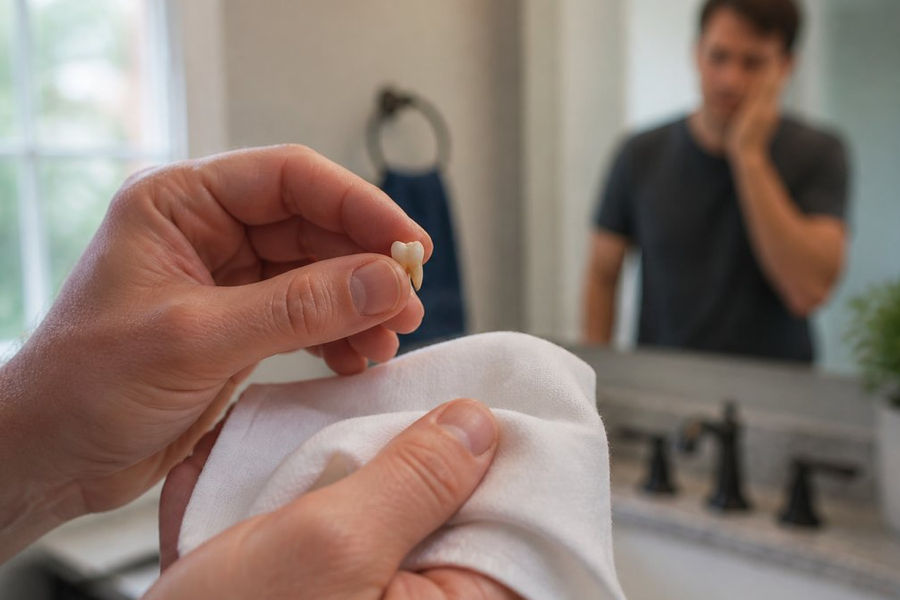
What you do for a knocked-out tooth in those first minutes matters more than anything else. Here is a step-by-step approach.
Step 1: Stay Calm and Find the Tooth
Panic wastes time. Take one deep breath, then find the tooth.
Pick it up carefully and keep track of it. Do not scrub it or scrape it. If the person is bleeding, grab a clean cloth or gauze first.
Step 2: Handle It by the Crown, Never the Root
The crown is the white part you see when you smile. The root is the part that was under the gum.
Touch only the crown. The root surface carries tiny fibers called the periodontal ligament that help the tooth reattach. Crushing or scraping them lowers the odds of saving the tooth.
Step 3: Control Bleeding and Manage Pain
Bite gently on clean gauze or a cloth to slow the bleeding. Change it every few minutes if it soaks through.
Apply a cold compress to the outside of the cheek to ease swelling and pain. A bag of frozen peas wrapped in a towel works well.
How to Preserve a Knocked-Out Tooth Before You Reach the Dentist
Keeping the tooth moist is the single most important thing you can do on the way to the emergency dentist.
The Four Transport Options, Ranked by What They Protect
Not all liquids are equal. The best medium keeps the root moist, stays close to the tooth's natural pH and salt balance, and does not swell or shrink the ligament cells.
Reinsertion in the socket, the gold standard. The socket is the tooth's natural environment, and every minute the tooth spends back in it is a minute the ligament is not drying out. Reinsert only if the tooth slides in gently and the socket is not crushed.
Holding it in the mouth, between the cheek and gum, or under the tongue if the person is alert and will not swallow it. Saliva is a reasonable short-term medium, but it is not sterile and the tooth can be swallowed or bitten. Use this only for the trip to the car or a short drive.
Plain dairy milk, the best household liquid. Milk's pH and calcium content are close enough to the tooth's environment that it does not shock the ligament cells the way water does. Use plain milk, not flavored, sugary, or plant-based alternatives.
Saline solution, a good backup when milk is not available. Contact-lens saline or a homemade saltwater mix works in a pinch; avoid anything with preservatives or additives.
Specialized Tooth-Preservation Kits vs. Household Liquids
Most articles stop at milk. A tooth-preservation kit (often sold as a save-a-tooth or dental-saver kit) contains a balanced cell-preserving solution and a mesh basket that holds the tooth without crushing the root.
The trade-off is availability: a kit only helps if it is on hand when the injury happens. Milk is in nearly every refrigerator, which is why it remains the most practical default.
Pro Tip If you are unsure which medium to use, choose milk. It is the most forgiving household option and is far better than a dry tissue or a cup of tap water.
What Never to Use
Tap water, the wrong salt concentration can swell and burst ligament cells.
Dry tissue or paper towel, wicks moisture away from the root.
Alcohol, mouthwash, or hydrogen peroxide, kills the cells you are trying to save.
A Quick Decision Path
Tooth slides back in easily? Reinsert it and bite on gauze.
Cannot reinsert but the person is alert? Hold it in the cheek on the way to the car, then move it to milk.
Have a preservation kit? Use it.
Whatever you choose, bring the tooth and the container with you. Do not clean out the container before the dentist sees it, the medium itself tells the dentist how the tooth was stored.
The article ranks the transport options for a knocked-out tooth by how well each one protects the periodontal ligament.
Transport option | Rank | Key note |
Reinsertion in the socket | Gold standard | Natural environment; reinsert only if it slides in gently |
Holding it in the mouth | Second | Saliva is short-term; risk of swallowing or biting |
Plain dairy milk | Best household liquid | Close pH and calcium; no flavored or plant-based |
Saline solution | Good backup | Contact-lens saline or homemade saltwater; no additives |
Knocked-Out Tooth in Milk: Why It Works and How to Do It
Plain milk is one of the best transport mediums for a knocked-out tooth. It keeps the root moist and roughly matches the tooth's natural environment, which helps protect the ligament cells.
Here is how to store a knocked-out tooth in milk:
Get a clean cup or small container.
Pour in enough plain milk to cover the tooth.
Place the tooth in crown-first, root down.
Cover the container and keep it cool.
Bring it with you to the dentist right away.
Use plain dairy milk, not a flavored or sugary drink. If milk is not available, saline solution is a good backup.
How Long Can a Knocked-Out Tooth Survive?
A knocked-out tooth has the best chance of survival when it is back in the socket within about 30 minutes.
The tooth can still be saved in some cases after a longer delay, but the periodontal ligament starts to break down the longer it stays out.
Do not wait to see if the pain fades. Call a dentist and head in as soon as you can.
Reinserting the Tooth: What to Do and What to Avoid
If you can reinsert the tooth safely, do it. Gently place it back in the socket by the crown, then bite down softly on gauze to hold it steady.
Stop and leave it alone if:
The socket looks crushed or badly injured
The tooth will not go in without force
The person is a young child who might swallow it
Watch out: Never force a tooth into the socket. Pushing hard can damage the bone and the root, and it can make the tooth impossible to save. If it does not slide in easily, keep it in milk and let the dentist handle it.
When to Seek Emergency Dental Care
Call for emergency dental care right away for any knocked-out permanent tooth. This is always a dental emergency, even if the person feels fine and the bleeding has stopped. The clock on the ligament is still running.
Adult (Permanent) Teeth vs. Baby (Primary) Teeth
The advice changes depending on which tooth came out.
Permanent tooth, attempt reinsertion if you can do it gently, preserve it in milk or a kit, and get to a dentist within the first 30 minutes if possible. A permanent tooth that is not replanted promptly has a much lower chance of long-term survival.
Primary (baby) tooth, do not try to reinsert it. Putting a baby tooth back can damage the developing permanent tooth underneath. Place the child's tooth in milk or saline, keep the child calm, and call a pediatric dentist the same day. A knocked-out baby tooth is still urgent, but the goal is protecting the adult tooth that will come later, not saving the baby tooth itself.
If you are not sure whether a tooth is primary or permanent, treat it as permanent and call a dentist, the dentist can tell you within seconds.
Warning Signs That Mean Go Now, Not Later
Seek urgent help if you notice:
Heavy bleeding that will not stop after 10 to 15 minutes of firm gauze pressure
A tooth that is loose, cracked, or pushed out of place
Swelling around the face, jaw, or eye
What Happens After the Emergency Visit
Most patients are surprised by what comes next, so it helps to know the sequence. After the dentist confirms the tooth can be saved, the typical path looks like this:
Splinting, the tooth is stabilized to its neighbors with a flexible wire or splint for roughly one to two weeks so the ligament can begin to reattach.
Follow-up visits, the dentist checks for signs of reattachment and watches for root resorption, a process where the body slowly breaks down the root of a tooth it does not recognize.
Root canal treatment, many replanted adult teeth eventually need a root canal, often within weeks of the injury, because the blood supply to the pulp is severed when the tooth leaves the socket.
Long-term monitoring, even a successfully saved tooth is usually checked for a year or more, since resorption and discoloration can appear months later.
Knowing this in advance helps set expectations: saving the tooth is the first win, but keeping it is a process, not a single appointment.
Key Takeaway A knocked-out permanent tooth is a race against time; a knocked-out baby tooth is a race to protect the adult tooth underneath. Either way, call a dentist the same day.
For a chipped or cracked tooth instead of a fully knocked-out one, you can read our guide on how to treat a chipped tooth at home safely while you arrange an appointment.
What to Avoid When a Tooth Is Knocked Out
Some common first-aid habits do more harm than good. Skip these:
Do not scrub or rinse the root with tap water
Do not touch the root with your fingers
Do not let the tooth dry out
One note on rinsing: advice differs between experts. The American Association of Endodontists suggests a gentle water rinse for a dirty tooth, while the American Academy of Pediatrics advises milk or saline and warns against tap water. When in doubt, skip the rinse and get to the dentist.
Get Same-Day Help for a Knocked-Out Tooth
A knocked-out tooth is stressful, and you should not have to sort it out alone. You can book an urgent dental appointment online right away. Our team at Royal Dental at The Villages has over 30 years of experience. First-time patients can also view our new patient special before booking an emergency visit. Confirm that we serve your location before you call for same-day help.
Frequently Asked Questions
Can a knocked-out tooth be put back in?
Yes, in many cases a permanent tooth can be reinserted if you act fast. Pick it up by the crown, not the root, rinse it briefly, and either place it back in the socket or keep it moist in milk or saline. The American Association of Endodontists notes that replanting as quickly as possible gives the best chance of saving the tooth. Primary (baby) teeth should not be reinserted. Call a dentist immediately after.
Should I put a knocked-out tooth in milk?
Milk is one of the best transport mediums for a knocked-out tooth because it keeps the root surface moist and has a similar pH to the mouth. Place the tooth in a small cup of plain milk and head straight to the dentist. If milk is not available, saline solution or the tooth's own socket works. Avoid tap water for storage, since it can damage the periodontal ligament cells.
How quickly should I see a dentist after a tooth is knocked out?
See a dentist within 30 minutes if possible. University of Florida dental experts say the first 30 minutes after a dental injury are critical for saving the tooth. Even if you cannot get in that fast, keep the tooth moist and get to a dental professional the same day. Time-sensitive care gives the best chance of successful replantation.
What should I do if I cannot find the knocked-out tooth?
If you cannot find the tooth, control any bleeding with clean gauze and a cold compress. Do not probe the socket with your fingers or tools.
A knocked-out tooth can be saved, but only if you act quickly and handle it the right way. At Royal Dental at The Villages, we combine 30 years of experience with same-day implants, full-mouth restoration in 24 hours, and a 10% new-patient discount on dental work and implants. Our team offers a comfortable, safe environment built around your needs. Get started with Royal Dental at The Villages and protect your smile today.

Comments